Snehal Shah ARCHITECT

list of selected projects

ARCHITECT’S OFFICE, AHMEDABAD

info

ARCHITECT’S OFFICE, AHMEDABAD

Ahmedabad, 2000

The site is very tight, 11 x 16 m. rectangular in plan; the building has four storeys and a basement level, a rarity in the city.
The building faces south onto a suburban road. The eastern (main entry) facade has a three-storey void rising from the ground floor, bringing daylight and air to each floor. For eight months a year, air-conditioning is unnecessary, as this central light well acts as a thermal chimney and induces good cross ventilation.
The 12 m-wide building is divided into three parts, with the central core housing a lift and staircase. The three concrete parts are independent, connected by the steel and timber staircase.
The ground level is given over to an entry lobby; a reception area is to one side with an informal seating area opposite, opening onto a small garden facing the road. this undercroft area has a table where staff gather for breaks. The basement houses the library. Around 30 people occupy the building.
The first-floor houses administration, with the model-maker on the north side. On the south side is a lecture room. The office frequently hosts lectures, inviting professors and practicing architects to present work to students and young architects.
The second floor has an open design studio on the south side and office on the north.
The third floor has another small library and a conference room.
The structure is finished in exposed concrete both outside and inside, and bands of red Agra stone on the east, south and north external elevations contrast with the grey concrete.
Concrete fins, 1200 mm wide, on the north and south counteract the harsh sun. Windows have sills 300 mm above floor level and extend to the underside of ceiling beams. They are double-glazed with a 12 mm air gap, hermetically sealed. This cuts glare and traffic noise. Surrounding the frames are dark green marble slabs waterproofing the building. The same green marble is used for the flooring, evoking a cool, natural metaphor inside.

TCS IT/ITES SEZ GARIMA PARK, GADHINAGAR

info

TCS IT/ITES SEZ GARIMA PARK, GADHINAGAR

With Engineering Design and Research Centre (Larsen & Toubro)

Gandhinagar, 2009

The design of the software center is based on the single workstation unit and its need for optimal light. Everything revolves around the workstations housed in the central block. Ten thousand are accommodated; the design allows 20 per cent more workstations without the need for an additional building.
Two support blocks flank the central main block. Containing stairs, toilets, services, as well as lecture rooms, auditorium, conference rooms and reception; the support blocks are located to be conveniently close to the workstations.
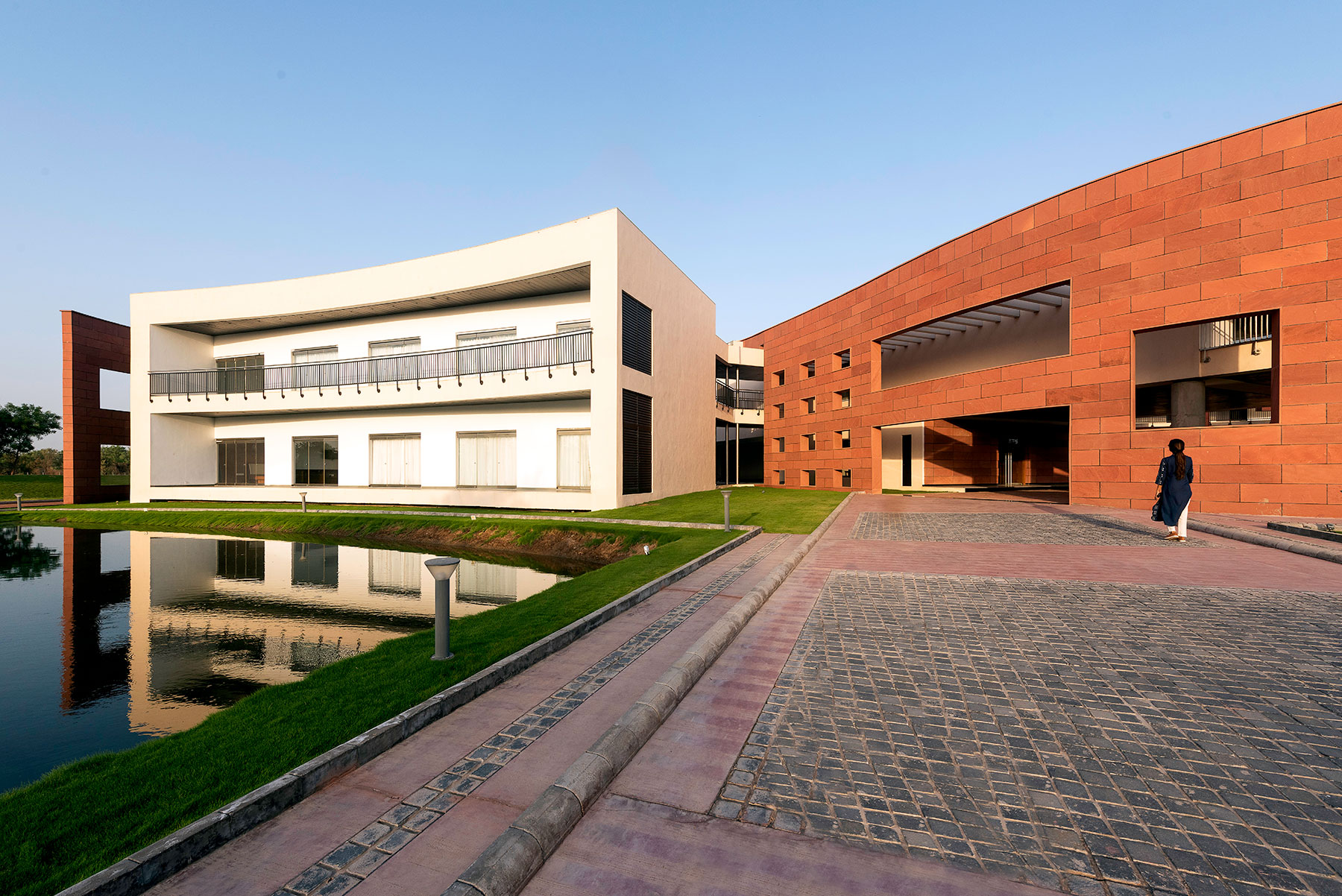
The west block contains administration and management departments with a multipurpose hall; the east block has a canteen and being on the east side will remain cool. Outside the canteen is a moat that can serve as a small amphitheater.
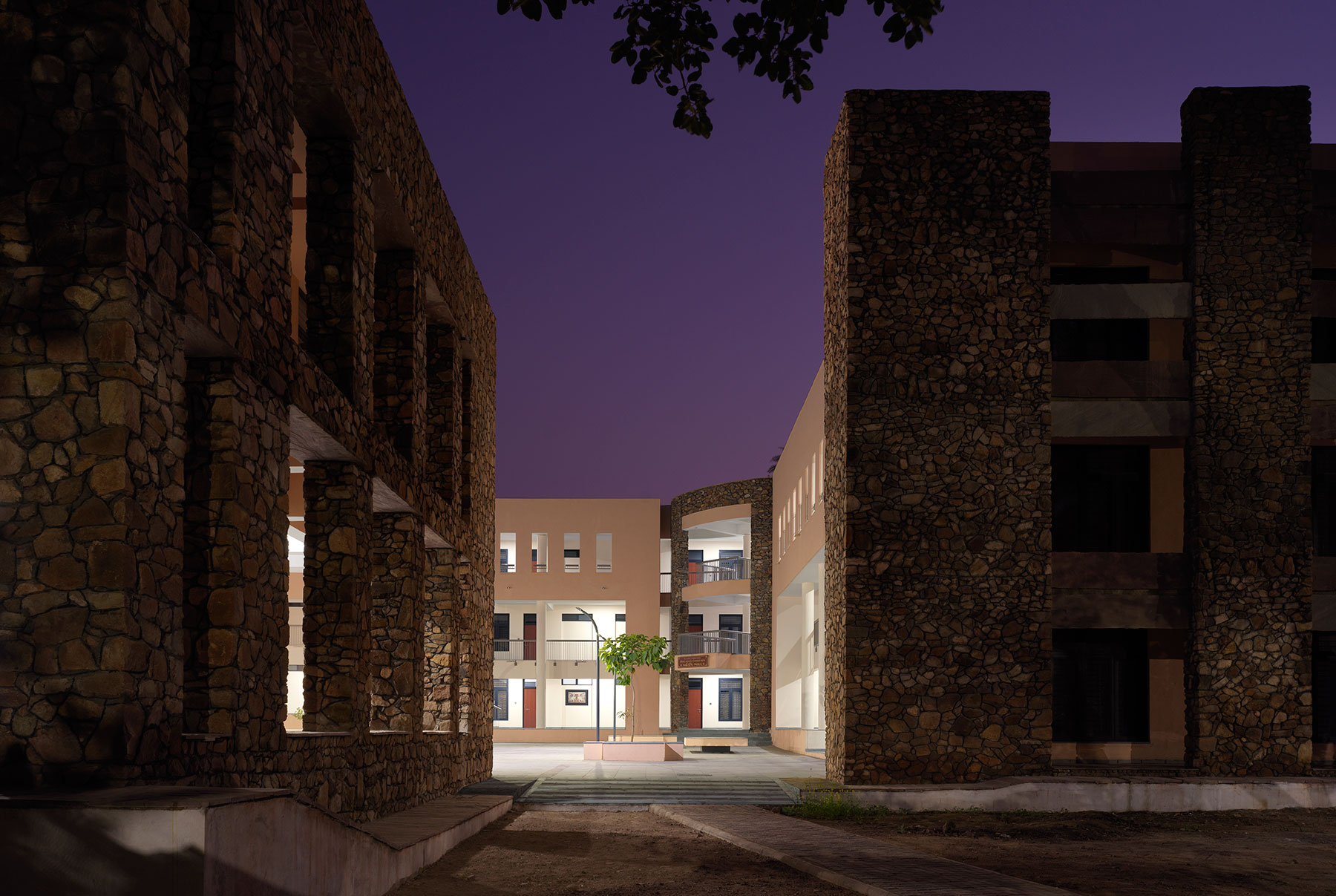
Locally available stone is used on the banded facades and for flooring.

RAM KRISHNA MISSION TEMPLE, PORBANDAR

info

RAM KRISHNA MISSION TEMPLE, PORBANDAR

Porbandar, 2001

A great earthquake struck Gujarat in 2001 and caused heavy destruction across a vast area, including remote villages. Education in these villages came to a standstill, with buildings ruined or damaged.
The Ram Krishna Mission approached Snehal Shah Architects to rebuild schools. Around 160 basic school structures were built in record time, with the practice overseeing the work. The client was pleased and also commissioned the architects to build a temple in Bharwada. A modern architectural vocabulary was sought, rather than replicate the conventional temple design with gods and goddesses ranged around the walls.
The temple is located in the main square, in the midst of the township. The plan is a square that becomes an octagon as it rises towards the pyramidal roof. An upside down quinch creates the stepped form of the pyramid.
An open prayer/audience hall allows breezes in from all directions. Wooden doors on the axis of the temple create an enclosure to the shrine.
The expected temple symbols are present. The flagpost is located on top of the pyramidal roof. The front prayer hall is square, creating a joint between the main shrine and prayer hall and forming a circumambulation (Pradakhshina path). Two squares are generally put together in the place where the idol is located: the two squares accord with stipulations in the religious architectural treatises. The squinches are placed in the four corners, acting as four guardians to ward off evil spirits.
The front pyramidal roof over the prayer hall is glass to maximize natural light; and the sun is expressed implicitly as the supreme power.

FAMILY GUEST HOUSE, BHAT

info

FAMILY GUEST HOUSE, BHAT

Bhat, 2004

The house is located on former agricultural land that has now been overtaken by low-rise information technology developments.
The client desired serenity. The site is approximately 45,000 sq. m., a generous area distancing the noise and bustle of the city. the single-storey house is sited at the center of a garden and surrounded by trees. Its only visible presence is a sinuous, punctured wall that protects the building and discloses it progressively as one approaches along the drive.
The residence is linear in plan, running east-west to maximize solar/shade orientation and cross ventilation. The front door is at the eastern end. It opens onto a 40 m, quarter-arched circulation spine that is both corridor and verandah. Lateral walls segment the sinuous exterior wall, creating nooks for seating and the display of art works. Deep punctures admit north light and breezes.
The rooms of the house are located along the southern side of this spine. Activities are planned around two courtyards. The semi-private spaces – the dining room, prayer room and the formal living room – are placed on three sides of the first courtyard. The kitchen is located behind the dining room, with a rear entry for servants. Further along are the private spaces – three bedrooms – located to form a second courtyard.
The two open courtyards bring light into living areas and enable air circulation, modulating the temperature inside.
The house is clad in stone, and stone is also used internally. It is a grounding material, evoking nature and the rustic contrast to the city. A wide green lawn spreads out along the northern side of the house.

AMRUT MODY SCHOOL OF MANAGEMENT, AHMEDABAD

info

AMRUT MODY SCHOOL OF MANAGEMENT, AHMEDABAD

with SL Shah, civil engineer

Ahmedabad, 2005

The corner site of the management institute campus has busy main roads on two frontages. Across the lesser crowded road is the Indian institute of Management – Ahmedabad (IIM-A) designed in 1962, by the great modern master, Louis Kahn.
The new college is built well back from the main roads. In front of the building, a wide lawn spreads across the site to the boundaries, an appropriate setting for a civic building. in the dense urban fabric of Ahmedabad, this garden and recreational space provides a welcome oasis.
Entry to the institute is from an internal road. The building takes the form of a quadrant in plan. Two perpendicular arms pivot around a cylindrical tower housing a staircase. The arc inscribed between the two perpendicular arms faces the main road. An internal courtyard is created between the three wings, serving and connecting them and providing a central focus for informal interaction and various activities. Dramatic shallow curved arches on the courtyard elevations and the cylindrical staircase block pay homage to the Kahn building opposite.
The two perpendicular buildings house classrooms. The curved wing has the library and computer labs.
On the ground floor, a large space overlooking the grounds can be used for college and other events.
External elevations are distinguished by bold cut-out apertures, symmetricality, and alternating striped bands of stone and pale grey exposed concrete emphasizing the horizontality of the building and reinforcing its grounding. Vertical fins on the teaching block elevations reduce sunlight and glare. Signature circular windows, in conjunction with large square openings, present a defining image of the institute to the main road.

FAMILY HOUSE 03, AHMEDABAD

info

FAMILY HOUSE 03, AHMEDABAD

Ahmedabad, 2007

A suburban house on a large open plot, with simple requirements and a constrained budget. The house is located for the best orientation in the hot climate, to encourage south-west breezes and yet keep out heat.
The rectangular ground floor contains a formal living room, dining hall, kitchen, master bedroom and a puja (prayer) room.
From the entry porch, it is possible to look through the house to a lush garden beyond. Breezes and natural light flow inside. Floors are green stripes of marble inlaid with white.
The first floor contains a study, two bedrooms and a verandah with views over the large garden.
The cubic volume produces a minimalist image enhanced by the cladding of white plaster and red Agra stone. The interior also has a minimalist aesthetic, with traditional memories held in the crafted timber furniture and objects of the house.

KUMBHARIYA CAMPUS DEVELOPMENT, BANASKANTHA

info

KUMBHARIYA CAMPUS DEVELOPMENT, BANASKANTHA

Banaskantha, 2019

FAMILY HOUSE 01, AHMEDABAD

info

FAMILY HOUSE 01, AHMEDABAD

Ahmedabad, 1987

One of the earliest projects undertaken by the practice was a house designed for a couple with two children.
The two-storey brick house occupies roughly half the site. It has a paved court on three sides, with the fourth, rear, elevation facing south onto a sloping lawn. The main entry is on the north.
The house is square in plan with rooms organized around a top lit central atrium that performs as a thermal chimney, exhausting hot air through the skylight. Cavity walls on the east and west help insulate the house from severe summer heat. A verandah acts as a heat buffer and allows in breezes.
All the living spaces are located on the south to take advantage of prevailing south-west breezes. Balconies on both levels of this elevation help shade the interiors. The facade is symmetrically organized, with a central element projecting above the roofline; this contains the staircase and gives access to the roof terrace.
The equally symmetrical though more formal north facade has a first-floor balcony to encourage natural ventilation through the central atrium/ thermal chimney.
Brick is an efficient material for Ahmedabad’s climate. The house is built in exposed brick with exposed reinforced concrete columns. Exterior walls are faced in alternating courses of stretchers and headers.

TEMPLE WALL, NADIAD

info

TEMPLE WALL, NADIAD

Nadiad, 2007

When a client bought a 20,000 sq. m plot as farmland away from the city, a very small, derelict temple to Shiva was discovered on the land. Although the idol was in good condition, the walls of the temple needed restoring.
We were asked to clad the temple walls in small marble sheets 8-10 mm thick.
We thought the new cladding should have its own identity. However, the budget was tiny. Our only choice was to design marble bands, alternately receding and flush. The banding, with the thickness of the marble creating variable shading as the day progresses, registers a subtle statement of the sun, a supreme universal force and divinity.
This simplicity and minimalism is carried throughout, to the corners and roof detailing.
Instead of cantilevering the roof – chhajja – in the traditional manner, we added a small band of another marble (green Kesariajee). Protruding bands of marble on the four walls, to the same dimension as the green band, create shadow and accentuate the transition of wall to wall and roof to sky.

GUESTHOUSE FOR CADILLA PHARMACEUTICALS LTD. DHOLKA

info

GUESTHOUSE FOR CADILLA PHARMACEUTICALS LTD. DHOLKA

Dholka, 2018

UN MEHTA INSTITUTE OF CARDIOLOGY, AHMEDABAD

info

UN MEHTA INSTITUTE OF CARDIOLOGY, AHMEDABAD

Ahmedabad, 1992

The four-storey hospital was constructed over a period of four years. In the first phase, the basement and ground floor were built. Medical equipment was stored in the basement; the ground floor housed the basic facilities of the cardiology hospital. Three additional floors were added in the second phase.
Linear in plan, the hospital is organized along a wide central spine running north-south. Banks of rooms are clustered on either side of the organizing spine. Being a specialty hospital, all the rooms are located according to functional hierarchy.
Planning departs from the stereotypical model of long hospital corridors. Circulation spines are punctuated by widened areas and courtyards; these bring light, ventilation and glimpses of nature inside. Three 80-year old neem trees in the courtyard are co-opted into the design.
Exterior walls are finished in rough aggregate in two shades: thin dark bands and thicker, lighter bands of colour.

SHIVAM HOSPITAL, NADIAD

info

SHIVAM HOSPITAL, NADIAD

Nadiad, 2005

The hospital is located in a prime area of the town of Nadiad, which is 70 km from Ahmedabad. The site is narrow but prominently situated at the end of the road. There are limited set-backs on the north-west and south-east boundaries. Within these constraints, the planning achieves an expressive, memorable image for hospital facade, as well as the required parking area for the site
The gently concaved main frontage reads against the other buildings on the street. the circular windows establish a bold symmetrical pattern framing the central main entry and giving scale to the building, defining the four storeys. Entry is via a ramp directly into the reception courtyard.
The central four-storey atrium is the soul of the hospital, light-filled, legible, providing orientation for all the floors.
Typically, hospital planning follows a repetitive internal organization, with services dominating the exterior. Here, there are no long corridors. Rooms address the central oval atrium. Translucent roofing over the atrium captures good light and brings it deep inside the building, at the same time casting a serene glow over the entire interior environment. The modulation of daylight also reduces mechanical and electrical loads.

FAMILY HOUSE 04, UDAIPUR

info

FAMILY HOUSE 04, UDAIPUR

Udaipur, 2009

Udaipur has a climate of extremes: temperatures reach over 45 degrees centigrade in summer and fall to 5 degrees in winter.
The clients, a married couple, were both doctors. They wanted a range of requirements: good breezes throughout the year; the harsh sunlight filtered; the ground floor free for yoga activities; a comfortable verandah on the first floor for meditation; the ground floor at the back opening onto a garden; ideally, no maintenance. Also they wished their house to express the vibrant cultural heritage of Udaipur.
The local red kachia stone has been used as wall and ceiling infills in vernacular buildings for more than 100 years. this stone has the capacity to span very long lengths. it was an obvious and practical choice to use the local stone, which is cheaply available, requires no maintenance and has good thermal properties, summer and winter. Positioning thin red stone slabs outside the large windows cuts glare, funnels breezes and casts good shadows, cooling the outside wall.
Almost a square, the plan is simple, with a central atrium allowing hot air to evacuate and breezes to enter the house. Functions are arranged around the central court, reprising the cross plan first developed in the Parikh and Adani houses.
Living activities take place on the first floor: formal living room, bedrooms, meditation room, dining and kitchen.

ANAR CHEMICALS FACTORY AND OFFICE EXTENSION, AHMEDABAD

info

ANAR CHEMICALS FACTORY AND OFFICE EXTENSION, AHMEDABAD

Ahmedabad, 1992

The chemical factory, office extension and gatehouse were an early commission.
The location is an industrial complex. Usually, such a program would be purely utilitarian with little opportunity for architectural expression. Here, the two-storey office facade is given a noble treatment: a grand entry opens onto a sky lit central foyer. While many industrial buildings are lightweight, this building has the authority of solidity and mass, which is suggested by the plastered brick fins.
Modeling on the main facade also creates patterns of deep shadow in the bright sunlight. The rippling fins protect windows and reduce glare. Climbing vines growing in built-in planting boxes provide a sense of cool refuge from the heat of the plain.
Where the use and manufacture of chemicals are concerned, the key requirement is to ensure ample open space for fumes to disperse. The warehouse, storage for raw materials and pulverize room, in contrast, needed to be enclosed.
Maintenance was also a specific consideration. The factory regularly releases acidic fumes, and the space requires additional coats of paint periodically.
A courtyard performs well, especially in summer, cooling the ground and first floors and bringing in light. The courtyard also ameliorates the industrial factory character.

FAMILY HOUSE 02, AHMEDABAD

info

FAMILY HOUSE 02, AHMEDABAD

Ahmedabad, 1988

The structure of the house was influenced by the choice of building material: brick. It is faced with aggregate plaster and polished grey Kota stone bands.
The siting on the narrow plot allows a front garden and minimal margins to boundaries.
With the limited side boundary margins, the first floor slab is extended to incorporate balconies. The under surface of the balcony is coated with white plaster to reflect ambient light.
Circulation and services are ordered centrally as a cross, defining four living spaces. A small courtyard, similar to those of traditional pol houses, forms the central space of the house.

BK MAJUMDAR INSTITUTE OF BUSINESS ADMINISTRATION, AHMEDABAD

info

BK MAJUMDAR INSTITUTE OF BUSINESS ADMINISTRATION, AHMEDABAD

with SL Shah, civil engineer

Ahmedabad, 2000

The institute teaches an undergraduate commerce program. the new four-storey building accommodates nearly 1000 students.
It is located on an existing campus, the rear frontages (east and south) backing onto site boundaries and the main, northern, facade addressing a large sports oval and parking. The building completes a line of existing buildings.
The semi-arch on the northern face was intended to be a full arch but was not built as designed.
Entry is through a large two-storey lobby. An airy central courtyard at the heart of the building, open to the sky, contains a staircase and creates a shaded space for students to mingle and for informal activities and cultural festivals to take place. Here the sense of being inside and outside is blurred.
Classrooms occupy the first and second floor. Semi-open spaces are provided here, rather than on the ground floor, for circulation and interaction among the students.
Rooms on all floors are planned around the c-shaped courtyard. Wide corridors flank the courtyard and bring sun-screened natural light into all the classrooms.
The middle portion of the c plan on the second floor projects and is supported by double-height columns. This creates a shaded informal space below.
Construction was carried out in phases. Each completed phase was sufficiently flexible to enable the addition of further elements.

VICE-CHANCELLOR AND REGISTRAR’S HOUSE GUJARAT VIDHYAPEETH, AHMEDABAD

info

VICE-CHANCELLOR AND REGISTRAR’S HOUSE GUJARAT VIDHYAPEETH, AHMEDABAD

Ahmedabad, 2011-2012

Gujarat Vidhyapeeth is one of the few surviving educational centres dedicated to the Gandhian philosophy. It is situated on a large piece of land with abundant greenery, surrounded by the sprawling city of Ahmedabad. The brief was to design houses for the vice-chancellor and registrar: modest in requirements, set among trees, minimal in cost and low in technology. The brief also requested a ‘Gandhian style’.
The C-shaped plan ensures light and ventilation and provides a rear courtyard around which the living areas are grouped.
An existing tree on the site was retained and incorporated as part of the verandah. Columns supporting the tiled sloped roof emerge directly from the ground instead of being placed on a plinth or on the verandah. To bring in light from the north, the roof is elevated at the center of the house. Windows are full-height; services are centralized; and the semi-open rear courtyard of the C-shaped plan is the living space.

WEEKEND HOUSE, SURAMYA, AHMEDABAD

info

WEEKEND HOUSE, SURAMYA, AHMEDABAD

Ahmedabad, 2012

A very small brief for a weekend family house on a very small plot: 23 x 15 m. The house is only 13 x 7.75 m, leaving as much of the site as possible free. Two sides face roads; the north elevation looks onto a common plot.
On the ground floor is a small bedroom, a kitchen, a hall and dining area opening onto one large space for weekend get-togethers.
The north-south axis is kept free.
The first floor opens on three sides to take advantage of the views.
The house is elevated on the site and seems to be floating.

ARCHITECT’S RESIDENCE, AHMEDABAD

info

ARCHITECT’S RESIDENCE, AHMEDABAD

Ahmedabad, 2005

The three-storey house occupies a large corner site, with roads on the north and west, and is surrounded by somewhat taller, high-density residential buildings. the quiet residential colony is in the midst of a commercial area in the city.
The rectangular plan stretches north-south along one side boundary to best capture prevailing south-west breezes. the main, western facade looks onto a lush green lawn and garden occupying two thirds of the site. This facade is deeply undercut to provide shade to balconies opening onto the living and bedroom areas.
A formal entry is across the lawn to the central foyer on the ground floor. the other entry, from the north, is via the undercroft double garage.
On the ground floor, separate from the main volume of the house, is a guest suite with entrance, and servants’ quarters.
In the foyer, a timber staircase wraps around the central lift core. The first floor contains the main living spaces: a large formal living room on the north; an open bridge crossing the undercut double-height volume to an informal sitting area located centrally between living room and dining room on the south with its open balcony overlooking the garden. The bridge creates a visual connection and also helps generate cooling airflow.
The second floor contains the private spaces. Bedrooms and studies are ranged on either side of the staircase/lift core. the north wing has a small balcony that juts over the garden; and a larger secluded central balcony is a pleasant place to sit in the cooling breeze.
The rooftop, like many houses in India, is trafficable, and it’s from here that kites are flown during festivals.
The main facade is finished in exposed concrete revealing the shuttering pattern, and contrasting peach-coloured plaster.

previous
  • Projects
  • Research
  • About
next